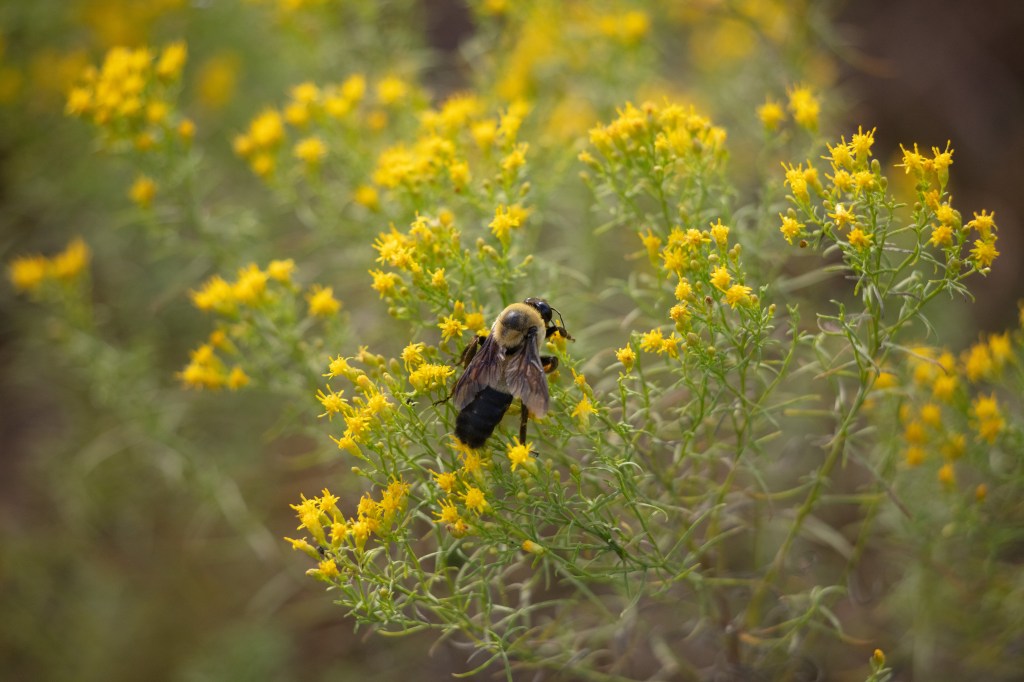
Wandering amidst the Fall Line Sandhills in Piedmont Georgia, wrapped up, as we sometimes are, in her private sorrow, Sarah Kelsey finds release in an “Encounter with a Bee”:
“A small thing grabs my attention and narrows it to a focused pinpoint of seeing, studying, wondering, then knowing. Movement among the flat-topped goldenrod, large and black. A carpenter bee?
Quickly, the bee lifts to another goldenrod cluster, and I see its abdomen—fuzzy, unlike a carpenter bee, and huge! Another quick movement reveals a wide band of yellow. Replacing all else in my mind is a question: Who is this bee?
I move closer. The bee lets me. It flies around and among the small yellow flowers; I keep my focus on the bee, waiting for a view that will give me some information. Briefly, I see two stripes on the long abdomen, one curved in the middle like a Cupid’s bow. I still don’t know what kind of bee this is.
The bee lands on a flat-topped goldenrod. The goldenrod is a pure bright yellow, its slender stem holding clusters of many tiny flowers, small sunbursts, above delicate, short, thin leaves. The flowers are like the gentle autumn sun brought down to earth, with the same gentle warmth.
The bee turns, and I see the thorax, at its center a black ellipse that reminds me of both an eye and a gibbous moon, ringed by two yellow crescents. Suddenly, this bee is familiar: Bombus fraternus, the endangered Southern Plains bumblebee. It is the largest one I have ever seen.
Though perhaps never common, greater numbers of Bombus fraternus once occupied the grasslands of the Southeast. The conversion of these lands to farmland—destroying habitat, introducing pesticides, and wiping out the wildflowers that Bombus fraternus depends on for food—has halved its population. Unaware and in spite of these threats, this huge, healthy male bumblebee feasts on forage flowers, a gift from the fires of last spring. He has left his colony to seek a mate; she too has left her birthplace somewhere in these sandhills to find him. If they find each other, after their meeting, she will hibernate for the winter and emerge as next spring’s new queen.
I watch Bombus fraternus travel among the goldenrod, my sorrow silenced and my fatigue forgotten.”
Sarah’s essay is one of fifty works featured in the just-published 2024 issue of Deep Wild: Writing from the Backcountry. To learn more, visit www.deepwildjournal.com
 Deep Wild Journal