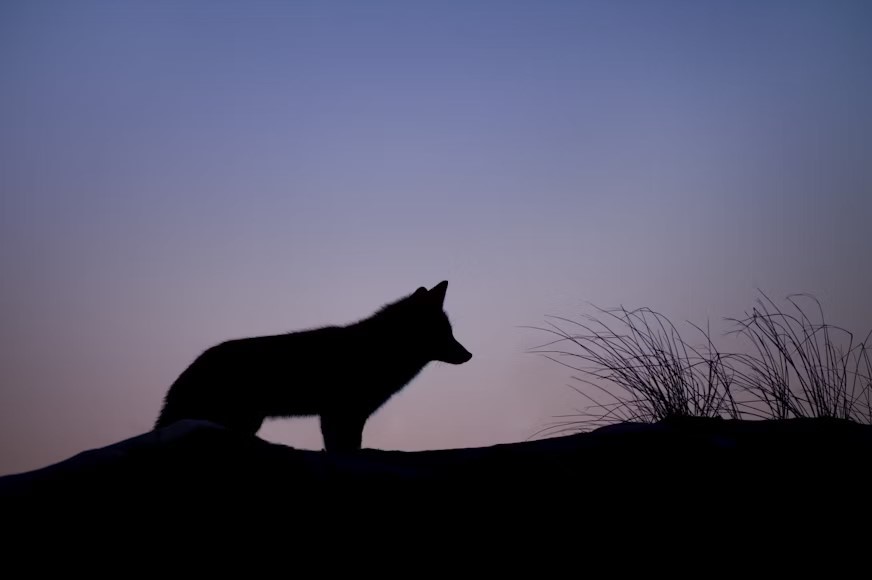
We are pleased to print in its entirety Sophie Hoss’ delicate story “Little Beast,” which received an Honorable Mention in the 2024 Deep Wild Student Contest. Sophie is an MFA candidate in Creative Writing and Literature at Stony Brook University in New York.
Little Beast
by Sophie Hoss
You scared me at first.
I don’t know how long you watched me, but when I noticed you, a gasp hitched in my throat. We stared at each other, still as fixed stars. The dark stretch of grass yawned between us.
Amber eyes, unblinking. Matted fur and pointed ears. You cocked your head.
Your move.
Barely breathing, I slid off the porch and lifted my arm towards you.
“Hi,” I whispered. “It’s okay.”
Your nose twitched. There was a terrible nakedness as your eyes prowled over me. Whatever you saw made you slink forward, head ducked low, and snuffle at my hand. You were roughly the size of a teddy bear.
There was no collar, no name tag. No other houses in sight. A one-stoplight town a half-hour drive down the mountains.
“Where’d you come from?”
Don’t remember. What kind of question is that, anyway?
Your skin stretched tightly over your ribs. I inched back inside and left the screen door propped open behind me. When I returned with a bowl of water and a piece of canned chicken, I kept my eyes lowered, dreading looking up to find you gone. But there you were, waiting.
At the time we met, it been a few months since Willa passed. I found that she was even louder in death than she was in life. People still called the house from time to time, and whenever they did, I promptly fell back into my role of her assistant. I had been hired as a live-in nurse, but over the years, the medical and personal meshed until they were indistinguishable.
“Hermia Aldrich residence,” I greeted. Most people only knew Willa by her penname.
The caller would say they had an opening for a book signing, an available position as a workshop instructor, a pitch for a new series, or some other pressing opportunity. For all their supposed interest, they didn’t seem to be up-to-date on Willa’s current predicament.
“I’m sorry to tell you this, but Ms. Aldrich is unfortunately no longer with us. This is Sheridan James speaking, manager of the Aldrich estate.”
A click on the other end. I stood, grasping the phone like a lifeline as dust motes sighed past.
Those calls were really the only time I spoke. But once you came into the picture, my voice, hoarse with disuse, found its lilt again. I scolded you, I called after you, I chattered incessantly.
You were so skittish, and you cried whenever I left your line of sight: your claws dug into the bathroom door. You flung your body against the windowpane when I stepped outside to grab the mail. At night, you slept curled on my shoulder.
Being needed felt good.
It was odd to fall into some semblance of a routine, and stranger still to look after myself again with some regularity. Ever since the morning when I woke up and Willa did not, I hadn’t brushed my hair. Eaten only when I forced myself to—a spoonful of peanut butter, maybe a few saltines. I went days without sleeping and then went days without getting out of bed. Even as a kid, I was always a bit peaky-looking—mildly anemic, chronically underweight. I don’t want to know what I looked like during my time as a living ghost.
I was a little embarrassed by the state of the house when you arrived. Willa had enjoyed comfortable clutter— “Can’t stand when things are too neat,” she said. I disagreed, but over the eight years I worked for her, I became accustomed to the cabin’s decor. Even grew to like it quite a bit. From the seven cuckoo clocks to the framed comic book covers to the mismatched yard sale furniture, everything was patchworked and vintage, artfully worn. Soft jazz was always playing from a little silver radio.
Now, with one less person, it was suffocating—the cozy disarray had quickly devolved into a pigsty. I pretended to look away as you pawed at strewn boxes, peered at crusted dishes brimming in the sink.
Finally, I relented.
“I’m getting this place in order,” I announced.
You paused from gnawing on the table leg and blinked. About time.
“I don’t know what to do,” I told you as I cleaned. “She left me this cabin. And some money.”
Oh?
“But I have nowhere to go.”
You’re stuck.
You padded over to me, and I knelt down to stroke your head. You leaned into the touch.
The backyard went as far back as we wanted it to. The New Hampshire forest was dense and limitless, lush with wet dirt and mist and bird cries, clustered with spruce and birch and mountain maple. I knew these woods like a map of the subway—over the years, I’d made countless routes and trails to wander down, sometimes with Willa, but mostly on my own.
You yipped at my ankles as we tramped through knotted brush. Sunlight darted between boughs. You leapt clear over rotted trunks, you sloshed through creeks, you bounded in circles around me. Your tail wagged.
How great is this?
“It’s wonderful.” I was surprised at the bounce in my step. Sometimes I even caught myself humming as I walked.
I started bringing my sketchbook with me. Cross-legged on the ground, charcoal likenesses bloomed on the page: weathered pinecones, veined bark, my own smudged hand. Drawing was always a meditative escape—one I had been denying myself.
Every so often, your ears perked up. You would bolt off and return a few minutes later with a dead squirrel or chipmunk clamped in your jaw.
Just a little something. No need to thank me.
“Good boy, Jack.”
I tried, again, to put a resume together. I had a nursing license from Queensborough Community and a few months’ experience at a pediatrician’s office. My gig with Willa was the highlight of my career—unfortunately, I couldn’t exactly get a posthumous recommendation letter.
I wasn’t even sure I wanted to continue with healthcare. Willa had died at eighty-nine with diabetes, arthritis in both knees, osteoporosis, and a stubbornly erratic heartbeat. “Natural causes” was the hospital’s verdict.
I rambled to the EMTs about how I took her blood pressure twice a day and administered her pills and insulin injections. Every checkup I’d driven her to concluded with a clean bill of health.
“Sometimes, people just die,” one of the emergency room doctors said gently.
Objectively—professionally—I understood. But I was supposed to be the line of defense against natural causes. Willa’s daily medication schedule was still pinned to the refrigerator. I couldn’t make myself take it off.
On a whim, I dug out my set of paints and unfurled a canvas sheet from under my bed. Before I knew what I was doing, the outline of your face was bleeding onto the page in bristled gray brushstrokes. I felt your eyes on my back.
Do I really look like that?
“Approximately.”
You nuzzled your head onto my leg. I swished my brush into the pallet over and over in a mindless rhythm—a drop of paint on the tip, a skim across the paper, a dip in water, another drop. Your likeness faced me head-on, somber and elegant. Your eyes blazed eagle-like. Behind you, I dabbed in swirls of dark emerald.
Nice job.
“Don’t flatter me.”
The more I studied the picture, the more I hated it. Within an hour of completion, it was shredded in the garbage.
I fell into bed one night with one of Willa’s books—Cordially Yours. One of her earlier pieces, it detailed a long-distance friendship between two boarding school students. I had started it once and never finished. I wasn’t much of a reader—in my initial job interview, I shifted in my seat as Willa prodded about my favorite novels.
“I like working with people who have different brains,” she reassured me. “Sometimes I get tired of mine.”
I woke with my face pressed into Cordially Yours’ open pages. Some vague, unsettling dream had roused me. Your slumbering body was splayed across my stomach—your weight, once barely a pillow, now pushed uncomfortably on my ribs. Your brow crinkled, eyelids twitching. I wondered what you dreamt about. I rubbed your forehead with my fingertips, and you perked awake.
What’s wrong? You rolled to the floor in one languid motion.
“Nothing, nothing.”
I sat up and brushed an arm across my cheek, half-expecting Willa’s printed words to be smeared on my skin. My hand came away clean.
It’s late for you to be up.
According to the digital clock on my bedside table, it was early rather than late. A slim part in the curtains hinted a cobalt sky.
“I’m gonna step outside. Want to join me?”
Obviously.
Night air did wonders for me. As kid, I savored the view from my apartment’s fire escape. Light pollution bleached out the stars, but it was nice to just lean against the railing. Feel a little breeze—cold and delicious—and inhale the city’s erratic pulse. I always dreaded being called back inside.
You liked night air, too.
By this point, you had started to grow into your frame—your hollow sides filled out, your twiggy legs muscled. You now stood knee-high to me. A tall, quiet sentinel.
We sat on the wispy grass and watched the blackness flicker above.Constellations blazed, snagged in the Milky Way’s silver tendrils.
Minutes passed, then an hour. My eyelids heavied and burned, and each blink was more strenuous than the last. After a while, I stopped resisting.
A gargled screech pierced the silence. I jerked awake, whirled my head to where you were no longer crouched beside me but being clawed into the air by a ghost-white owl—it hovered several feet off the ground, eyes yellow and starved.
My scream lodged in my throat. The owl’s talons clutched your back and stomach, and its beak snapped out at your head. You writhed and panted. Helpless. I lunged at the owl without thinking. It skidded upward, away from my grasp, dragging you with it. I fumbled on the ground for a rock or a stick or an anything to throw.
But in a flash of teeth, your jaws were latched onto its wing. You tore at the feathered flesh, slicing it easily. The great bird ambled sideways and shrieked. A twist of your body, and your jagged-nailed paw punctured the owl’s stomach. The two of you crashed to the earth.
The owl keened and flapped its remaining wing pathetically. A soft, rolling chirp. Its eyes roved with blind fear. You pounced on the bird before it could move, ripping its skin, shredding its feathers with tooth and claw. Dark blood spattered your fur and mingled with your own fresh wounds. The crazed butcher ended abruptly—the owl went limp and still. You flung the carcass aside.
I only remembered to breathe when you nuzzled your wet snout against my ankle.
Sorry you had to see that. But in my defense, you weren’t much help.
I looked down. My legs were shaking, but I couldn’t feel the tremor. I couldn’t feel anything.
From then on, I kept you on lockdown. I would take you out just once a day for no more than ten minutes. I couldn’t burn away the image of you bloodied in the air, seconds from slaughter. How could I have just stood there?
It was hard to keep you reined in. Brief frolics in the woods couldn’t appease you—energy pulsated from your skin and trembled beneath your fur.
You stalked around the house, sidling against walls and bumping into furniture. I ignored you when you scratched at the door, pleading to go outside for the tenth time. You tugged on my pant legs as I drowned out your whines in busywork.
Let’s go, let’s go! What’s wrong with you?
If I still didn’t give in, you caved into a ball at my feet.
Fine. Have it your way.
When you had gone three days without eating, I drove you an hour and a half to the nearest veterinarian. You lolled in the backseat. I glanced at you in the rearview mirror every few seconds, knuckles ghastly white on the steering wheel.
By the time I eased you onto the examination table, you were in a fitful sleep. I ran my hands through your fur and whispered to you. Every so often, your glazed eyes winked open.
The veterinarian froze when she saw you.
“Ma’am, are you aware this animal isn’t a dog?”
“Pardon?”
Her gingery eyebrows vanished into her bangs. “This is a wolf.”
The words refracted off me. “What do you mean?”
She snapped on plastic gloves and crossed the room to where you lay. She pried open your jaw, peeled back your eyelids. “Where did you adopt him? And how long ago?”
“He was a stray puppy,” I said blankly. “I took him in about six months ago.”
Her eyes tightened. “And you didn’t bring him in for a checkup? Or call the station to report a found dog, see if someone was looking for him?”
“No.”
She waited for me to offer further explanation. None came.
“Well, what I’m looking at here is most certainly a pure wolf,” she said as she checked your pulse. “Or close to it.”
“What’s wrong with him?” I asked.
A sharp exhale. “I don’t know yet. I’d have to run some tests. But wolves in a domesticated environment are at higher risk for health issues than your average dog. Has he been getting exercise?”
“We go for a long walk every day.”
“For three to four hours?”
I hesitated. “I don’t know. Maybe.”
“Do you live in a spacious home?”
“Not really. It’s a little cabin.”
She shone a light into your ears. “Frankly, I think a big part of what’s going on here is canine depression. Your friend here just isn’t getting the freedom he needs.”
I ignored her. “Can you run the tests so I can find out what’s wrong?”
She paused.
“Because it’s illegal in the state of New Hampshire to privately own a wolf, I’m going to have to call Animal Control.”
When I tried to speak, I found that my tongue was latched to the roof of my mouth. The veterinarian pursed her lips.
“It isn’t safe to domesticate a wolf. It makes people nervous—wolves can be very loyal to one person, but their behavior is unpredictable. They’re hunters. You must know that.”
My lips were numb. “What’s gonna happen to him?”
She rested a gloved hand on mine, eyes round with sympathy. It was the first time another person had touched me in almost a year.
“If there was another option, I would absolutely give it to you.”
“Couldn’t—couldn’t he go back to the forest?”
“He’s been living with you for too long. If he can’t reacclimate to the wilderness, releasing him is a death sentence.”
“But it already is,” I insisted.
The veterinarian rose and pulled off her gloves, flicking them into the trash can. “I’ll give you a few minutes alone.”
She excused herself. When she came back into the room, we were gone.
Tires whirred on the pavement. I had lain you in the passenger seat, and at the car’s sudden jerking, you stirred and looked up blearily.
Where are we going?
“I don’t know,” I whispered.
We skidded onto the highway. I rolled the windows down to give you some air. You titled your snout to the wind.
“Is that a little better?”
You have no idea.
My foot was steady on the gas. Miles slipped under the tires. The surrounding trees grew denser and taller, but the mountains stayed rigid, never growing closer—silhouetted and locked in place against the sky. I didn’t know what would happen to you. But a trial by fire was better than no trial at all.
I finally pulled over and wove the car through a gap in the overgrown forest. You sat upright, nose sniffling at the earthy rot. It was dusk, and your eyes were bright in the gathering shadows.
I rested my hand on your head. “I’m so sorry. For everything.”
You did the best you could.
I wasn’t so sure, but I didn’t argue. You eased yourself onto my lap. We held each other for a long moment—you nestled your head in the crook of my elbow, and I cradled you like a newborn. You were so soft. Beneath my hand, your sides swelled with each breath. I nudged open the door and stepped outside.
You leapt noiselessly onto the ground, and our eyes cut into each other: a familiar stalemate. You whined as I began to walk backward, but you didn’t follow.
“Will you be okay?”
Your paws dug into the dirt.
Born for this.
As I started the engine, I nearly doubled over in the driver’s seat. I clenched my jaw against the dry sobs. I wouldn’t cave. I couldn’t. But as I backed up the car, desperation flooded in—I decided that if you came chasing after me, frightened and pleading, I would take you with me, I would figure something out, I would do anything you wanted, anything.
When I chanced a look back, you had vanished.
My shameful bargaining quieted, and the car broke through the forest’s hem and rattled back onto the highway. I wouldn’t return to the cabin tonight.
I stepped on the gas. I kept heading north.
 Deep Wild Journal